Black hole found at center of galaxy
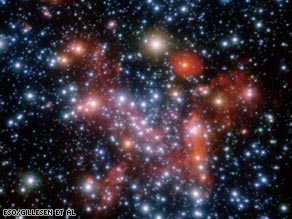
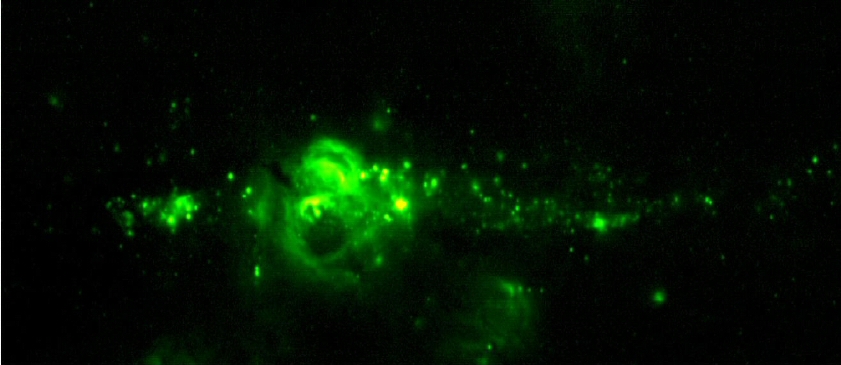
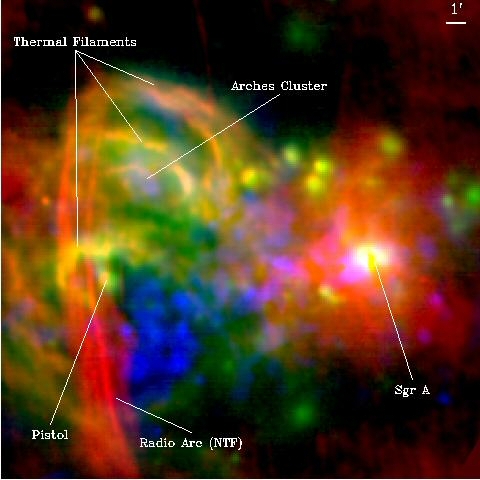
(CNN) -- German astronomers say they have discovered conclusive proof of a supermassive black hole at the heart of the galaxy. The 16-year study involved tracking the movement of 28 stars at the center of the Milky Way using telescopes at the European Southern Observatory in Chile. Using the data collected, astronomers were able to calculate important properties about the black hole -- called Sagittarius A* -- such as its size and mass. Professor Reinhard Genzel, who led the study at the Bavaria-based Max-Planck Institute for Extraterrestrial Physics, said the data collected proved the existence of the black hole "beyond any reasonable doubt." "Undoubtedly the most spectacular aspect of our long term study is that it has delivered what is now considered to be the best empirical evidence that super-massive black holes do really exist," said Genzel. The black hole had a central mass concentration of four million solar masses, he added.
The study also enabled astronomers to calculate the distance of the earth from the center of the galaxy, now measured to be 27,000 light-years, and enhanced by six times the accuracy to which they were able to measure the positions of stars -- the equivalent of seeing a one euro coin from a distance of 10,000 kilometers (6,214 miles). One star, called S2, orbited the center of the Milky Way so quickly that it completed one full revolution within the duration of the study. Genzel said the center of the galaxy was a "unique laboratory" for the study of the strong gravity, stellar dynamics and star formation with a level of detail "never possible beyond our galaxy." Stefan Gillessen, the chief author of the study, published in the Astrophysical Journal, said: "The Galactic Center harbors the closest supermassive black hole known. Hence, it is the best place to study black holes in detail." |
|
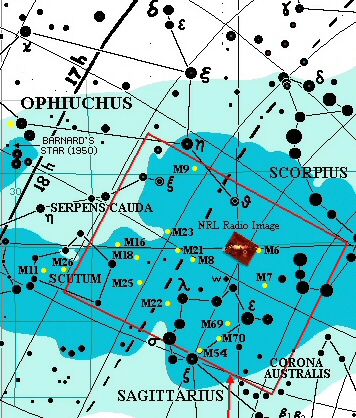
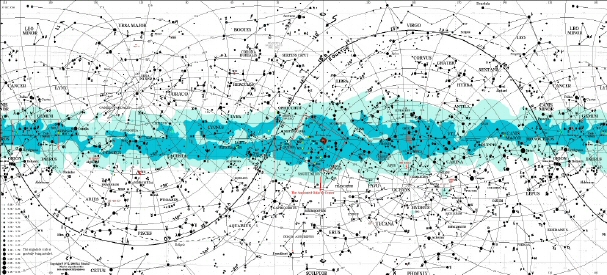
map of the Galaxy
the centre of the Galaxy - from our viewpoint on Earth - is between the constellations of Scorpio and Sagittarius - marked with a red square - the dark blue is the Milky Way .. thickest near the centre .....where there are the most stars
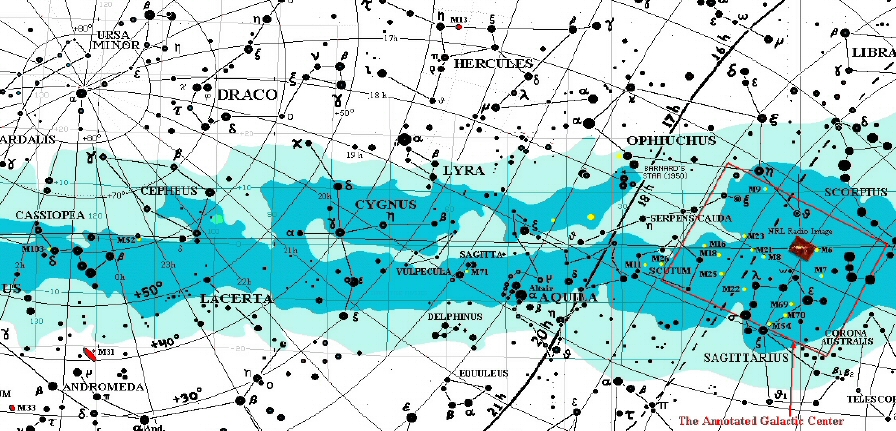
below is the area between the North Star ( Polaris ) and the Centre of the Galaxy - Cygnus the swan flies toward it
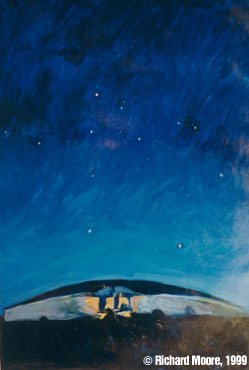
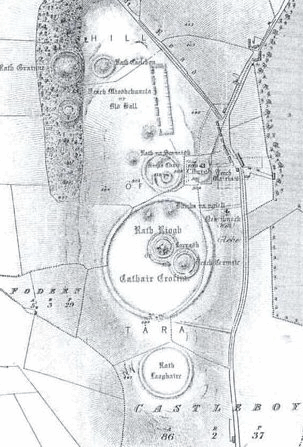
there has been research that the Constellation of Cygnus was important to Ancient Cultures - for instance at Newgrange - and seen as the bringer of Life see The Cygnus Mystery
|
US military website |
||
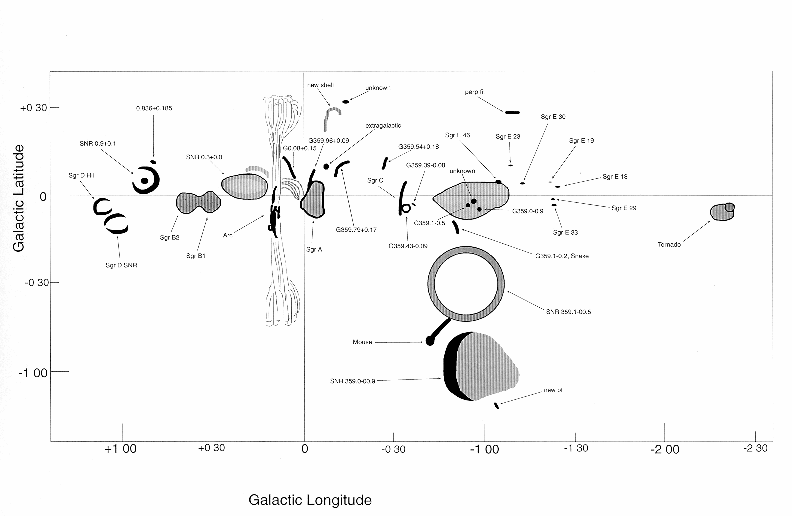
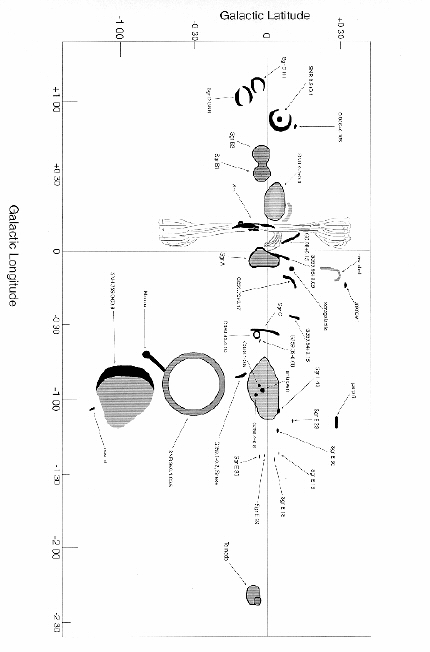
The Galactic Center
|
|
|
|
|
|
|
Astronomy Picture of the DayDiscover the cosmos!Each day a different image or photograph of our fascinating universe is featured, along with a brief explanation written by a professional astronomer. November 11, 1997
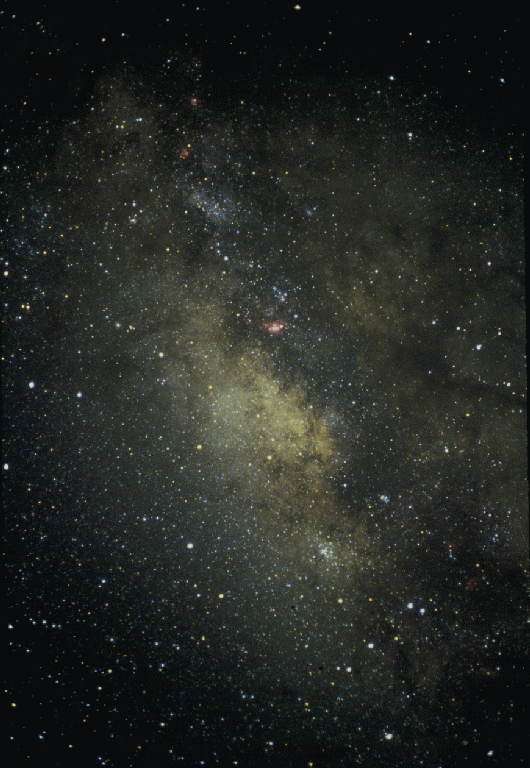
Credit: W. Keel (U. Alabama in Tuscaloosa), Cerro Tololo, Chile Explanation: The sky toward the center of our Galaxy is filled with a wide variety of celestial wonders. Most are visible with only binoculars. Constellations of nearby stars include Sagittarius, Libra, Scorpius, Scutum, and Ophiuchus. Nebulae include Messier Objects M8, M16, M17, M20 and the Pipe Nebula. Open clustersinclude M6, M7, M18, M21, M23, M24, M25. Globular clustersinclude M9, M22, M28, M54, M69, M70. And don't forget Baade's Window. Click on the photo to get the un-annotated version. <Archive | Index | Search | Calendar | Glossary | Education | About APOD >
|

|
|