
Song of the BacchantesComing from the Asian land,
|
 Mardi Gras and DionysosNew Orleans' spirit is embodied in its Mardi Gras. While New Orleans and the Gulf Coast are STILL not repaired or rebuilt since Hurricane Katrina (shame, shame, shame of a nation!), those who regard the city as a national treasure can continue to send support and cheer as the Saints ALMOST make it to the SuperBowl and Mardi Gras continues to express the city's unquenchable spirit of music and joy. The rites of Dionysos (or Bacchus) are an ancient analog of Mardi Gras. The illustration above shows a Bacchic parade, with a satyr playing the double flute and participants flourishing the thyrsus, a staff wound with ivy and vines and topped with a pine cone. The quotation this month is from Euripides' Bacchae. The chorus of Bacchantes, or women acolytes of Dionysos, sing of the joys of their rites of dance and song. They are depicted as having followed him from Mount Tmolus in Lydia to Thebes in Greece, where the play takes place. Religion of ecstasy and emotionDionysos was a god of ecstatic and emotional religion, different from the more stately cults of other Greek gods. The word "ecstasy" (ekstasis) means "a standing apart," or being "beside oneself." It refers to a trance state, which may be reached by wild dancing or by madness, in which one may actually become unconscious or see visions. The cult appealed to both sexes, but particularly to women. Its female votaries, or Bacchantes, were also called "Maenads" (Mainades or "madwomen"). The origins of Dionysos are unknown, but the cult may have come originally from Thrace, via Macedonia, to the north of Greece. His other name, Baccchus, on the other hand, is Lydian. In Euripides, we find him associated with the cult of Cybele, the Anatolian Great Mother goddess. The god was believed to be able to change his appearance, sometimes to that of a wild animal. Masks were sometimes worn by the dancers, though these were apparently human masks. Dionysos was also the god of wine, but that is only part of the story. Great festivals of Dionysos, eventually "domesticated" and civilized, became part of the fabric of classical Greece, and were the origin of the great Athenian comedy and tragedy, the most important celebration being the Great Dionysia, in early spring. Euripides' Bacchae would have been produced at one of these festivals. The Bacchae and a more primitive religionThe Bacchae (written after a visit by Euripides to King Archelaos of Macedonia), reveals the savage dark side of the Dionysiac religion. Dionysos is the son of Semele, daughter of King Cadmus of Thebes, by Zeus, who came to Semele in the form of a thunderbolt, which both impregnated and killed her. King Pentheus, son of Agave, another daughter of Cadmus, now rules Thebes (Cadmus is now retired). Pentheus, along with Cadmus' other daughters, Ino and Autonoe, have been disrespecting Dionysos, casting doubt on his divinity and attempting to jail his followers, who are dancing in the mountains. Dionysos takes revenge by driving the Theban women mad, and persuading Pentheus to go to the mountains to spy on them. His mother, Agave, tears him apart, thinking that he is a lion. The episode in which Agave realizes that she has killed her own son is one of the great tragic scenes.
|
|
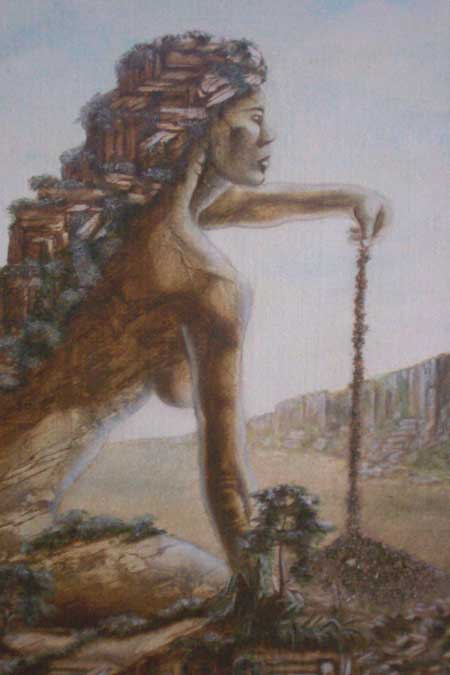
Element Earth, by Edith Egger.
|