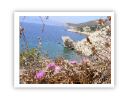
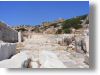
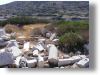
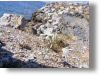
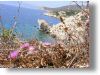
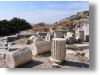
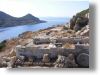
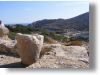
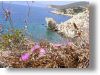
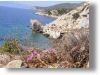
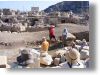
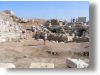
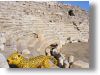
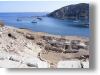
Cnidus or Knidos (Greek: Κνίδος /Knidos; at the modern-day locality called Tekir in Turkey) was an ancient Greek city in Anatolia, part of the Dorian Hexapolis. It was situated at the extremity of the long Datça peninsula, which forms the southern side of the Sinus Ceramicus or Gulf of Gökova. 36°41'8.99"N ; 27°22'31.60"E
It was built partly on the mainland and partly on the Island of
Triopion or Cape Krio. The debate about it being an island or cape is
caused by the fact that in ancient times it was connected to the
mainland by a causeway and bridge. Today the connection is formed by a
narrow sandy isthmus.
By means of the causeway the channel between island and mainland was
formed into two harbours, of which the larger, or southern, was further
enclosed by two strongly-built moles that are still in good part entire.
The extreme length of the city was little less than a mile, and the
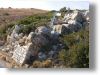
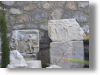
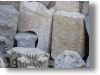
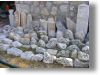
whole intramural area is still thickly strewn with architectural
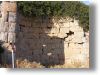
remains. The walls, both of the island and on the mainland, can be
traced throughout their whole circuit; and in many places, especially
round the acropolis, at the northeast corner of the city, they are
remarkably perfect. The first Western knowledge of the site was due to
the mission of the Dilettante Society in 1812, and the excavations executed by C. T. Newton in 1857-1858
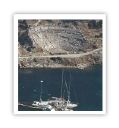
The agora, the theatre, an odeum, a temple of Dionysus, a temple of the Muses, a temple of Aphrodite
and a great number of minor buildings have been identified, and the
general plan of the city has been very clearly made out. The most
famous statue by Praxiteles, the Aphrodite of Knidos, was made for Cnidus. It has perished, but late copies exist, of which the most faithful is in the Vatican Museums. In a temple enclosure Newton discovered a fine seated statue of Demeter, which he sent back to the British Museum,
and about three miles south-east of the city he came upon the ruins of
a splendid tomb, and a colossal figure of a lion carved out of one
block of Pentelic marble, ten feet in length and six in height, which has been supposed to commemorate the great naval victory, the Battle of Cnidus in which Conon defeated the Lacedaemonians in 394 BC.
|
Engraving of a Knidian coin showing the Aphrodite, by Praxiteles
|

|
Knidos was a city of high antiquity and as a Hellenic city probably of Lacedaemonian colonization. Along with Halicarnassus (present day Bodrum, Turkey) and Kos, and the Rhodian cities of Lindos, Kamiros and Ialyssos it formed the Dorian Hexapolis, which held its confederate assemblies on the Triopian headland, and there celebrated games in honour of Apollo, Poseidon and the nymphs. ..................
.............
Eudoxus, the astronomer, Ctesias, the writer on Persian history, and Sostratus, the builder of the celebrated Pharos at Alexandria, are the most remarkable of the Knidians mentioned in history.
http://en.wikipedia.org/wiki/Cnidos