|
|


|
|
|
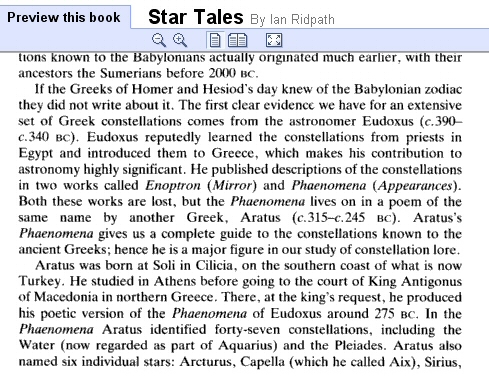



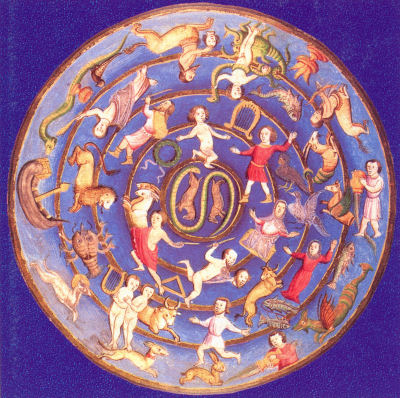
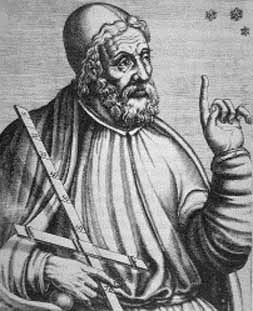
Constellation HistoryThe study of celestial objects is an ancient one. Knowledge of the sun, moon, and stars, and their associated mythology, was passed from generation to generation but few conclusive records of prehistoric observations survive.Constellations were part of the historical record in Mesopotamian culture around 4000 B.C. In the 9th century Homer mentioned a few now familiar constellations in his epic poem, the Odyssey. Five hundred years later Eudoxus of Cnidus wrote about 43 constellations (or 45 or 48 depending on one's interpretation) which survive today. Eudoxus' original work was lost but his ideas were kept alive by Aratus in a poem called Phaenomena.
|
the Phaenomena of EudoxusAratus of Soli (in Asia Minor) was a poet who lived circa 315 BC. - circa 245 BC. His most famous poem was called Phaenomena (circa 270 BC.) in which he wrote about the contemporary constellations. Aratus used the work of astronomer and mathematician Eudoxus of Cnidus , circa 400 BC. - circa 350 BC., as his primary constellation source. Phaenomena was commented on and translated numerous of times throughout the ages and has served as an important guide to the classical constellations. full text of Phaenomena - on website below ~
http://www.fillingthesky.com/phaenomena.html
|
|
eudoxus The Cambridge History of Hellenistic PhilosophyBy Keimpe Algra |
Historical Celestial Atlases on the World Wide WebMan has always been fascinated with the solemn and mysterious parade of the celestial luminaries across the night sky. As the earliest-known texts of various ancient cultures attest, the stars were commonly grouped into constellation figures which were believed to represent divine persons, sacred animals and other objects of religious importance.Of course, each of the major cultures stemming from the Near East, the Far East and the New World developed an indigenous system of constellation figures and associated legends which were recorded in written texts or depicted in maps or on globes. Of these various constellation systems, the Sumerian/Babylonian system of constellations would prove to be the most influential as it was their system that through successive adoptions, modifications and additions by Greek/Roman, Islamic and European astronomers evolved into the mathematically defined system of 88 constellations that is currently employed in the international astronomical community. Traditionally, astronomers plot the positions of the stars and the constellation figures in two ways:
|