Eudoxus of Cnidus
Born: 408 BC in Cnidus (on Resadiye peninsula), Asia Minor (now Knidos, Turkey)
Died: 355 BC in Cnidus, Asia Minor (now Turkey)
Eudoxus of Cniduswas the son of Aischines. As to his teachers, we know that he travelled to Tarentum, now in Italy, where he studied with Archytas who was a follower of Pythagoras. The problem of duplicating the cube was one which interested Archytas
and it would be reasonable to suppose that Eudoxus's interest in that
problem was stimulated by his teacher. Other topics that it is probable
that he learnt about from Archytas include number theory and the theory of music.
Eudoxus also visited Sicily, where he studied medicine with Philiston,
before making his first visit to Athens in the company of the physician
Theomedon. Eudoxus spent two months in Athens on this visit and he
certainly attended lectures on philosophy by Plato and other philosophers at the Academy which had only been established a short time before. Heath [3] writes of Eudoxus as a student in Athens:-
... so poor was he that he took up his abode at the Piraeus and trudged to Athens and back on foot each day.
After leaving Athens, he spent over a year in Egypt where he studied
astronomy with the priests at Heliopolis. At this time Eudoxus made
astronomical observations from an observatory which was situated
between Heliopolis and Cercesura. From Egypt Eudoxus travelled to
Cyzicus in northwestern Asia Minor on the south shore of the sea of
Marmara. There he established a School which proved very popular and he
had many followers.
In around 368 BC Eudoxus made a second visit to
Athens accompanied by a number of his followers. It is hard to work out
exactly what his relationship with Plato and the Academy were at this time. There is some evidence to suggest that Eudoxus had little respect for Plato's analytic ability and it is easy to see why that might be, since as a mathematician his abilities went far beyond those of Plato. It is also suggested that Plato
was not entirely pleased to see how successful Eudoxus's School had
become. Certainly there is no reason to believe that the two
philosophers had much influence on each others ideas.
Eudoxus returned to his native Cnidus and there
was acclaimed by the people who put him into an important role in the
legislature. However he continued his scholarly work, writing books and
lecturing on theology, astronomy and meteorology.
He had built an observatory on Cnidus and we
know that from there he observed the star Canopus. The observations
made at his observatory in Cnidus, as well as those made at the
observatory near Heliopolis, formed the basis of two books referred to
by Hipparchus. These works were the Mirror and the Phaenomena which are thought by some scholars to be revisions of the same work. Hipparchus
tells us that the works concerned the rising and setting of the
constellations but unfortunately these books, as all the works of
Eudoxus, have been lost.
Eudoxus made important contributions to the theory of proportion, where he made a definition allowing possibly irrational
lengths to be compared in a similar way to the method of cross
multiplying used today. A major difficulty had arisen in mathematics by
the time of Eudoxus, namely the fact that certain lengths were not
comparable. The method of comparing two lengths x and y by finding a length t so that x = m  t and y = n t for whole numbers m and n failed to work for lines of lengths 1 and √2 as the Pythagoreans had shown. t and y = n t for whole numbers m and n failed to work for lines of lengths 1 and √2 as the Pythagoreans had shown.
The theory developed by Eudoxus is set out in Euclid's Elements Book V. Definition 4 in that Book is called the Axiom of Eudoxus and was attributed to him by Archimedes. The definition states (in Heath's translation [3]):-
Magnitudes are said to have a ratio to one another which is capable, when a multiple of either may exceed the other.
By this Eudoxus meant that a length and an area do not have a capable
ratio. But a line of length √2 and one of length 1 do have a capable
ratio since 1 √2 > 1 and 2 1 > √2. Hence the problem of irrational lengths was solved in the sense that one could compare lines of any lengths, either rational or irrational.
Eudoxus then went on to say when two ratios are equal. This appears as Euclid's Elements Book V Definition 5 which is, in Heath's translation [3]:-
Magnitudes are said to be of the same ratio, the first to the second
and the third to the fourth, when, if any equimultiples whatever be
taken of the first and the third, and any equimultiples whatever of the
second and fourth, the former equimultiples alike exceed, are alike
equal to, or are alike less than the latter equimultiples taken in
corresponding order.
In modern notation, this says that a : b and c : d are equal (where a, b, c, d are possibly irrational) if for every possible pair of integers m, n
- if ma < nb then mc < nd,
- if ma = nb then mc = nd,
- if ma > nb then mc > nd.
Huxley writes in [1]:-
It is difficult to exaggerate the significance of the theory, for it
amounts to a rigorous definition of real number. Number theory was
allowed to advance again, after the paralysis imposed on it by the
Pythagorean discovery of irrationals, to the inestimable benefit of all
subsequent mathematics.
A number of authors have discussed the ideas of real numbers in the work of Eudoxus and compared his ideas with those of Dedekind, in particular the definition involving 'Dedekind cuts' given in 1872. Dedekind himself emphasised that his work was inspired by the ideas of Eudoxus. Heath [3] writes that Eudoxus's definition of equal ratios:-
... corresponds exactly to the modern theory of irrationals due to Dedekind, and that it is word for word the same as Weierstrass's definition of equal numbers.
However, some historians take a rather different view. For example, the article [15] (quoting from the author's summary):-
... analyses, first, the historical significance of the theory of proportions contained in Book V of Euclid's
"Elements" and attributed to Eudoxus. It then demonstrates the radical
originality, relative to this theory, of the definition of real numbers
on the basis of the set of rationals proposed by Dedekind. Two conclusions: (1) there are not in Book V of the "Elements" the gaps perceived by Dedekind; (2) one cannot properly speak of an 'influence' of Eudoxus's ideas on Dedekind's theory.
Another remarkable contribution to mathematics made by Eudoxus was his early work on integration using his method of exhaustion.
This work developed directly out of his work on the theory of
proportion since he was now able to compare irrational numbers. It was
also based on earlier ideas of approximating the area of a circle by Antiphon where Antiphon took inscribed regular polygons with increasing numbers of sides. Eudoxus was able to make Antiphon's theory into a rigorous one, applying his methods to give rigorous proofs of the theorems, first stated by Democritus, that
- the volume of a pyramid is one-third the volume of the prism having the same base and equal height; and
- the volume of a cone is one-third the volume of the cylinder having the same base and height.
The proofs of these results are attributed to Eudoxus by Archimedes in his work On the sphere and cylinder and of course Archimedes went on to use Eudoxus's method of exhaustion to prove a remarkable collection of theorems.
We know that Eudoxus studied the classical problem of the duplication of the cube. Eratosthenes, who wrote a history of the problem, says that Eudoxus solved the problem by means of curved lines. Eutocius
wrote about Eudoxus's solution but it appears that he had in front of
him a document which, although claiming to give Eudoxus's solution,
must have been written by someone who had failed to understand it. Paul Tannery
tried to reconstruct Eudoxus's proof from very little evidence, so it
must remain no more than a guess. Tannery's ingenious suggestion was
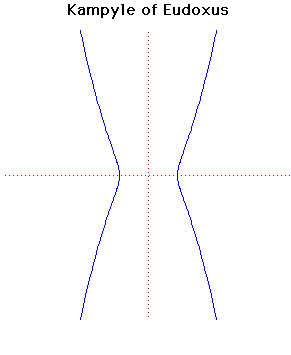
that Eudoxus had used the kampyle curve in his solution and, as a
consequence, the curve is now known as the kampyle of Eudoxus. Heath, however, doubts Tannery's suggestions [3]:-
To my mind the objection to it is that it is too close an adaptation of Archytas's ideas ... Eudoxus was, I think, too original a mathematician to content himself with a mere adaptation of Archytas's method of solution.
We have still to discuss Eudoxus's planetary theory, perhaps the work
for which he is most famous, which he published in the book On velocities
which is now lost. Perhaps the first comment that is worth making is
that Eudoxus was greatly influenced by the philosophy of the
Pythagoreans through his teacher Archytas. Therefore it is not surprising that he developed a system based on spheres following Pythagoras's belief that the sphere was the most perfect shape. The homocentric sphere system
proposed by Eudoxus consisted of a number of rotating spheres, each
sphere rotating about an axis through the centre of the Earth. The axis
of rotation of each sphere was not fixed in space but, for most
spheres, this axis was itself rotating as it was determined by points
fixed on another rotating sphere.
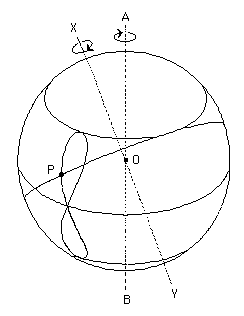
As in the diagram on the right, suppose we have two spheres S1 and S2, the axis XY of S1 being a diameter of the sphere S2. As S2 rotates about an axis AB, then the axis XY of S1 rotates with it. If the two spheres rotate with constant, but opposite, angular velocity then a point P on the equator of S1 describes a figure of eight curve. This curve was called a hippopede (meaning a horse-fetter).
Eudoxus used this construction of the hippopede with two spheres and then considered a planet as the point P
traversing the curve. He introduced a third sphere to correspond to the
general motion of the planet against the background stars while the
motion round the hippopede produced the observed periodic retrograde
motion. The three sphere subsystem was set into a fourth sphere which
gave the daily rotation of the stars.
The planetary system of Eudoxus is described by Aristotle in Metaphysics and the complete system contains 27 spheres. Simplicius, writing a commentary on Aristotle in about 540 AD, also describes the spheres of Eudoxus. They represent a magnificent geometrical achievement. As Heath writes [3]:-
... to produce the retrogradations in this theoretical way by
superimposed axial rotations of spheres was a remarkable stroke of
genius. It was no slight geometrical achievement, for those days, to
demonstrate the effect of the hypothesis; but this is nothing in
comparison with the speculative power which enabled the man to invent
the hypothesis which could produce the effect.
There is no doubting this incredible mathematical achievement. But
there remain many questions which one must then ask. Did Eudoxus
believe that the spheres actually existed? Did he invent them as a
geometrical model which was purely a computational device? Did the
model accurately represent the way the planets are observed to behave?
Did Eudoxus test his model with observational evidence?
One argument in favour of thinking that Eudoxus
believed in the spheres only as a computational device is the fact that
he appears to have made no comment on the substance of the spheres nor
on their mode of interconnection. One has to distinguish between
Eudoxus's views and those of Aristotle for as Huxley writes in [1]:-
Eudoxus may have regarded his system simply as an abstract
geometrical model, but Aristotle took it to be a description of the
physical world...
The question of whether Eudoxus thought of his spheres as geometry or a physical reality is studied in the interesting paper [29]
which argues that Eudoxus was more interested in actually representing
the paths of the planets than in predicting astronomical phenomena.
Certainly the model does not represent, and perhaps more significantly
could not represent, the actual paths of the planets with a degree of
accuracy which would pass even the simplest of observational tests. As
to the question of how much Eudoxus relied on observational data in
verifying his hypothesis, Neugebauer writes in [7]:-
... not only do we not have evidence for numerical data in the
construction of Eudoxus's homocentric spheres but it would also be
difficult how his theory could have survived a comparison with
observational parameters.
Perhaps it is just too modern a way of thinking to wonder how Eudoxus
could have developed such an intricate theory without testing it out
with observational data.
Many of the early commentators believed that Plato
was the inspiration for Eudoxus's representation of planetary motion by
his system of homocentric spheres. These view are still quite widely
held but the article [19]
argues convincingly that this is not so and that the ideas which
influenced Eudoxus to come up with his masterpiece of 3-dimensional
geometry were Pythagorean and not from Plato.
As a final comment we should note that Eudoxus also wrote a book on geography called Tour of the Earth
which, although lost, is fairly well known through around 100 quotes in
various sources. The work consisted of seven books and studied the
peoples of the Earth known to Eudoxus, in particular examining their
political systems, their history and background. Eudoxus wrote about
Egypt and the religion of that country with particular authority and it
is clear that he learnt much about that country in the year he spent
there. In the seventh book Eudoxus wrote at length on the Pythagorean
Society in Italy again about which he was clearly extremely
knowledgeable.
Article by: J J O'Connor and E F Robertson
Click on this link to see a list of the Glossary entries for this page
http://www-groups.dcs.st-and.ac.uk/~history/Biographies/Eudoxus.html
|




 (the required
 -dimensional
 , ...,
  . The
. The  -tuples of numbers
 fulfilling the equation are
the coordinates of the points of
fulfilling the equation are
the coordinates of the points of  .
.


 ))
))

 wikimedia curves -


![[Graphics:Images/index_gr_139.gif]](index_gr_139.gif)
![[Graphics:Images/index_gr_140.gif]](index_gr_140.gif)
![[Graphics:Images/index_gr_141.gif]](index_gr_141.gif)
![[Graphics:Images/index_gr_142.gif]](index_gr_142.gif)
![[Graphics:Images/index_gr_143.gif]](index_gr_143.gif)
![[Graphics:Images/index_gr_144.gif]](index_gr_144.gif)

